
Mictlantecuhtli statue in the Templo Mayor museum.
The origin shows details of a syncretism between different elements of the pre-Hispanic cult for the dead, the related Aztec and Mayan gods, and the Catholic Church.[2] The main elements found that can be distinguished are the following:
- Mictlantecuhtli and Mictecacíhuatl. Aztec god and goddess of death, darkness, and Mictlán “the region of the dead.”
- Day of the Dead. A Mexican celebration of pre-Hispanic origin that honors the deceased on November 2, begins on November 1, and coincides with the Catholic celebrations of All Souls’ Day.
- The Bible places death as one of the Horsemen of the Apocalypse in the first part of the 6th chapter of the Apocalypse, and Death and Hades in the last half of the 20th chapter of the Apocalypse.
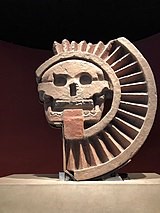
Sculpture with the face of death, emblematic piece of the National Museum of Anthropology in Mexico City. This image represents the presence of death in the pre-Hispanic cultural ideology.
The roots of the belief would date from pre-Hispanic times, under the name of Mictlantecuhtli and Mictecacihuatl as the god and goddess of death, darkness and Mictlán “the region of the dead” (a concept of duality was used in the Aztec religion ). Men and women who died of natural causes went to this place. But the road was not easy. Before appearing before the Lord and Lady of death, many obstacles had to be passed; stones that collide with each other, deserts and hills, a crocodile named Xochitonal, a wind of sharp obsidian stones, and a mighty river that the dead man crossed with the help of a dog that was sacrificed on the day of his funeral (Xoloizcuintl). From this branch, pre-Hispanic animism can be associated with the varied Catholic saints, in the style of Cuban Santeria, which combines African animist traditions with Catholicism.
In tradition, offerings were given to the owners of the underworld. This detail is very important since over time these offerings would continue to be present on the altars of Death.
Mictlantecuhtli and Mictecacíhuatl were undoubtedly the deities to whom the dead were entrusted, but they were also invoked by anyone who desired the power of death. His temple was located in the ceremonial center of the ancient city of Tenochtitlán.
ORIGINS
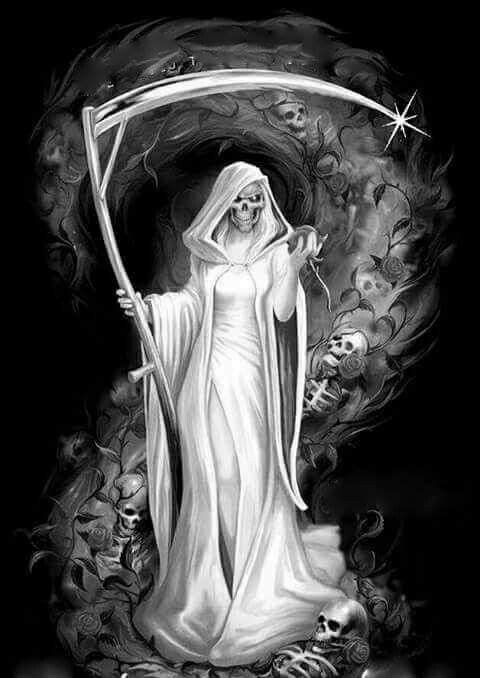
La Santa Muerte, also known as Santísima Muerte, is the beloved goddess of death, whose origins date back to Mexico’s pre-Hispanic period. The Mexicans knew her by another name: MICTECACIHUATL “Lady of the Land of the Dead”; another spelling could be MICTLANTECIHUATL, believed to protect souls residing in the dark underworld. Mistress of MICTLANTECAHTLI Lord of the Land of Mictlan of the Dark Lord died. Santa Muerte is represented as a woman in traditional Mexican clothing, adorned or decorated with flags that were placed on the corpses prepared for cremation. She wears a skull mask with a spike protruding from the skull mask’s nasal cavity, or maybe it’s a knife or blade. Mictecacihuatl is the goddess that is linked to the sacred day of the dead in Mexico: Dia de los Muertos, originally the festival was held at the end of July and beginning of August, dedicated to children and the dead. The festival was moved by Spanish priests to coincide with Halloween, a vain attempt by the church to turn this holy day into a Christian holiday. However, the Day of the Dead preserves its ancient roots by honoring the Lady of the Land of the Dead. It is said that the old gods are not dead, but are sleeping and can be awakened by faith and prayer. Mictecacihuatl and his lord Mictlantecahtli received blood offerings from the Mexican who asked them in exchange for a favorable or peaceful death when the time to die had come. Tradition says that in order to receive a favorable fate when making an offering, one must have their right hand covered in blood to ensure Lord Mictlantecahtli’s favor. As blood offerings were considered of paramount importance, the color red became intimately associated with the Lord of the Land of the Dead, and by extension, the color is assigned to his lover due to his connection to his Lord. It is important to note that Mictlantecahtli and her lover Mictecacihuatl lived in total darkness. Although there is no specific reason why the goddess of death gained such popularity, one theory is that she survived post-conquest times thanks to her protective role and very important role. in celebration of the day of the dead.A celebration dear to the heart and soul of any Mexican who loves their ancestors and who worships their ancient ancestors and the deities they once venerated. It is said that the ancient gods did not simply die forgotten but are waiting to be awakened by the fire of the faithful, I believe this is true for Mictecacihuatl. The Lady of the Dead did not suffer the same fate as the Virgin of Guadalupe, who was originally a Mexican goddess known as Tonantzin (Moon Goddess and softer aspect of Coatlicue) wrath from missionaries who tried to Christianize Tonantzin by declaring that she it was the Virgin Mary in her ideal image who came to lead the pagans to Christ. Mictecacihutal has retained its true appearance, although its image has changed by syncretism as in its current form, Santa Muerte.
Santa Muerte and its different forms
It is believed that the veneration of Santa Muerte in its current form really took hold in Hidalgo Mexico around 1965. In its modern form, Santa Muerte is a syncretic image that retains its powers and attributes as Mictecacihuatl, the lady of the dead; a protector of souls and children. Today it bears the image of an almost sinister angel of death, taken from the European necromantic traditions that influenced Mexico. In addition, she bears images or icons that designate or identify her as Mictecacihuatl, such as the owl that is often depicted on Santa Muerte statues. The owl is one of the animals associated with Mictlantecahtli, the Lord of the Dead, whose lover Mictecacihuatl was, a very strong image in Mexican culture to this day. Some statues represent Santa Muerte as a reaper with a scythe holding a balance and a crystal ball, others just carrying the balance and a crystal ball. Another interesting comment, she is sometimes depicted in art as holding a terrestrial globe which represents her power in other representations: she is holding a skull, then of course there is the hourglass. Another name that people use for her is “La Catrina”, which is her classic image in Dia de los Muertos art by José Guadalupe Posada, which depicts her as a skeletal woman from high society. That is why some of his death stories include syncretic themes such as a link between the Devil and Death; both are syncretic forms of ancient Mexican deities: the Devil is the black Tezcatlipoca and Death is Mictecacihuatl, the Lady of the Dead.
The magic of the goddess of death
Just like in Antiquity, Mexico made sacrifices to the Lord and Lady of the Dead to receive a peaceful death, this tradition has been passed down from generation to generation and has become a myriad of requests. The basic demand always remains for a peaceful death, but Santa Muerte can be requested for almost any human need. There are rituals for prosperity, business success, justice (judgment), protection from evil, protection from enemies, spiritual purification/healing, attraction of a lover, return of a lost love, domination , even curses against enemies, the reversal of curses to name a few. There are herbal baths made in your name for spiritual cleansing, spiritual healing, good fortune, baths to open your paths to success. Amulets are made on his behalf for various needs and oils are also made on his behalf. Santa Muerte has a complete system of magic, which is rare because many traditions attribute special requests to different saints that Santa Muerte can grant to everyone. There are very few folk saints who have this power; the holy lady is one of those rare deities. Efforts seem to be made to identify Santa Muerte as venerated primarily by drug dealers, smugglers, prostitutes, and gangsters. This image is widely promoted by Catholic officials in Mexico who wish to give it a bad image, although it is true that these people revere it; These people are not the majority. Remember that the faithful come in all shapes and sizes and come from all walks of life.
MOORINGS ARE MADE
EMPTY

BLACK WITCHCRAFT

SEPARATIONS
ROOMS CALL FOR YOUR CONSULTATION