



madonnapreston
madonnapreston
How to evaluate capital expenditures before a loan decision?
Before you borrow for new equipment, a vehicle, or a second location, the core task is to estimate the cash the purchase will create and compare it with what the loan will cost each month. That comparison is the heart of how to evaluate capital expenditures. In practice, it means testing the numbers when sales come in below plan, because a loan does not wait for a slow year.

Start with the decision the loan is meant to support
The loan should follow one specific decision, not a general wish for more room. Name the purchase in a sentence, such as replacing a packaging line that stops every few weeks or adding a second delivery van. A vague request for working capital makes the evaluation harder, because nobody can say which cash flows the loan is supposed to create, or whether those flows will ever show up.
Separate capital expenditures from ordinary operating costs. A capital expenditure is spending on something the business will use for more than one year, such as machinery, vehicles, a build-out, or software you own outright. Payroll and rent are operating costs. The distinction matters because your accounts and your lender will treat the two differently, and mixing them can make the cash picture look better or worse than it really is.
For illustration only, imagine a small food manufacturer that wants a $240,000 packaging line. The current line breaks down often, the owner expects the new one to speed up output, and the bank has offered a five-year loan. The owner is not asking whether the business needs a better line. The real question is whether the new line will generate enough cash to cover the loan payments, with room to spare when something goes wrong.
Write the decision as one sentence with a date and an owner. For example: “We will buy the line only if its extra cash can cover its own loan payments in the first three years, and the owner signs off by the end of the quarter.” That sentence gives the rest of the work a target. Without it, every tab in the spreadsheet turns into a debate about what you hoped the purchase would prove.
A useful check at this stage is to ask who will read the result. A lender wants to know whether the debt gets repaid. An owner wants to know whether the purchase adds value to the business. A finance leader wants both answers, plus the assumptions behind them. If you cannot say who will read the model and what they need from it, you are not ready to build it yet.
Build the cash the purchase will actually produce
The cash a purchase creates is not the same as the profit it shows on paper. Start with the extra money that comes in because of the asset, then subtract the extra money that goes out because of it. The result is the incremental cash flow, and it is the number that pays the loan. Everything else in the model supports or challenges that single line.
Count only what changes because of the purchase. If the new line adds output you can sell, include the added sales, but only the margin you would actually keep after the materials and labor that go with them. If the line saves labor, count the saving only when you can reduce hours or move people to paid work. Overhead that stays the same, such as rent for the existing building, stays out of the calculation unless the purchase changes it.
Ramp-up matters more than most owners expect. A new machine rarely reaches full speed on the first day, and the team needs time to learn it, troubleshoot it, and build the routines around it. Model the first year below the steady state and write down why. A slow start is often the reason a payback that looked fine on a spreadsheet disappoints in the bank account, so give that period its own line.
Include the ongoing costs as well: maintenance contracts, spare parts, insurance, power, software licenses, and the training hours that pull people away from other work. Taxes belong in the model too, because depreciation and the timing of deductions change how much cash you keep. If you are not sure how the rules apply to your company, that question goes to your tax professional or accountant, not to a guess buried inside the model.
Keep the incremental cash flow separate from the working capital effect. A bigger production line often means more inventory on hand and more receivables waiting to be collected. That cash leaves the business even though the sale is already recorded. A line that doubles output can strain cash in its first year, even when it is profitable over time. This is where a monthly cash forecast earns its keep, because it shows the gap that an annual summary can hide.
Compare payback, net present value, and internal rate of return
Three measures do most of the work in a capital expenditure review, and each one answers a different question. Used together, they give a fuller picture than any single number. Used alone, each can mislead, especially when the cash flows are uneven or the forecast is shaky.
| Measure | Question it answers | What it can hide | When it helps most |
|---|---|---|---|
| Payback period | How many years until the cumulative cash covers the original outlay | Cash that arrives after the payback point, and the time value of money | Tight cash situations and loans with short repayment terms |
| Net present value | How much value the project adds in today’s dollars at a chosen discount rate | Its dependence on the discount rate and on how accurate the forecast is | Comparing projects of different sizes or lives |
| Internal rate of return | The rate of return the project earns on its own cash flows | Odd results with uneven or unusual cash flows, and weak comparisons across different project sizes | Comparing the project with the cost of borrowing |
Payback period counts how long the cash takes to return the initial spending. Using the packaging line example, suppose the incremental cash flows are $55,000 in year one, $70,000 in year two, $80,000 in year three, $80,000 in year four, and $70,000 in year five. Those figures are hypothetical. Cumulative cash reaches $205,000 after three years, so the line returns its $240,000 cost at about 3.4 years.
Net present value discounts each year’s cash back to today at a rate you choose, usually tied to what money costs your business. At an assumed 10 percent rate, those same hypothetical flows add up to a present value of about $266,000, which leaves a net present value of about $26,000. A positive result means the project clears that rate on paper. The answer moves when the rate moves, so write the assumed rate next to the result and explain where it came from.
Internal rate of return is the discount rate at which net present value becomes zero. It is easy to compare with a loan’s interest rate, which is why owners and lenders both like it. The catch is that it can look impressive on a short, front-loaded project and misleading on one with uneven cash flows or several sign changes. Read it next to net present value instead of relying on it alone.
No single measure settles the decision. Payback tells you how long the business stays exposed to the investment. Net present value tells you how much value the project adds at your chosen rate. Internal rate of return gives you a percentage you can compare with the cost of the loan. If all three point the same way, the case is stronger. If they disagree, the disagreement is itself the most useful finding.
Test the numbers when sales come in below plan
A good evaluation asks what happens when the forecast is wrong, because it usually will be wrong in some way. The most useful tool for this is a sensitivity check: change one key assumption at a time and watch what happens to the result. For most equipment decisions, the biggest assumption is volume, meaning how much extra output you can actually sell at the margin you expect.
Return to the hypothetical packaging line. If every year’s incremental cash flow came in 20 percent lower, the flows would be about $44,000, $56,000, $64,000, $64,000, and $56,000. Payback stretches to roughly 4.2 years, and net present value at the same 10 percent rate turns negative, around minus $27,000. A project that looked comfortable at plan can fail on a modest miss, and that is exactly what this test is meant to reveal.
Run the downside as a named scenario. The base case shows what you expect, the slow case shows a realistic shortfall, and the stress case shows what happens if your largest customer leaves or input prices rise. Keep the loan payments fixed in every scenario, because the lender will expect those payments whether the line performs or not. Changing the payments along with the cash flows hides the real exposure.
Test timing separately from volume. A one-year delay in ramp-up can matter as much as a lower sales figure, because the loan payments start on schedule regardless. Then ask what changes next if the first year is slow: can the business cover the gap from other cash, and for how many months? A month-by-month view makes that gap visible, while an annual model can smooth it away and leave you surprised.
The goal is not to prove the project works in every case. The goal is to learn which assumption carries the decision. If the answer hinges on one customer order or one supplier price, you know where to spend your effort before you sign, and what data to ask for. If the project survives every reasonable scenario, you can sign with more confidence, knowing you have already seen the bad versions of the story.
Count the costs that show up after the purchase day
The purchase price is the first cost, not the full cost. Many owners budget carefully for the machine and forget what it takes to make it run well. A useful review lists every cost that begins, grows, or changes because of the asset, including costs that appear months later. Missing even one category can change the payback enough to matter.
Installation, freight, site preparation, and electrical work usually belong in the initial outlay. Training and the first weeks of reduced productivity may belong there too, since they are real cash spent to get the asset working. Lenders often finance the equipment price but not everything around it, so check what the loan actually covers before you assume the total spending is financed.
After the purchase, look at maintenance, service contracts, spare parts, consumables, insurance, and any software or controls the asset needs to operate. Some assets also bring compliance costs, such as inspections or permits, depending on your industry and location. Ask the vendor for the expected service schedule in writing, then compare it with what your own team can handle without outside help. The gap between those two lists is often where the surprises hide.
Plan for the end of the asset’s useful life, too. Equipment that works well today may need replacement sooner than the loan term runs. If the loan lasts seven years but the machine may need replacing in five, the cash for that replacement belongs in the picture. A model that treats the asset as free once the loan is paid off will look better than the business will actually be, and that gap tends to show up at the worst possible moment.
Track these costs in the same chart of accounts you use for daily bookkeeping. Tools such as QuickBooks or NetSuite can tag asset-related spending, so you can compare the forecast with actual results after the purchase. Without that link, the model stays a document nobody checks once the loan closes, and the next capital decision starts from memory instead of evidence.
Read the loan terms as part of the project math
A loan is more than a payment schedule. The terms shape how much room the project has, and some of them matter more than the interest rate. Before you compare offers, read the whole agreement, or ask someone who understands lending to read it with you. A low rate with tight conditions can be a worse deal than a higher rate with flexible ones.
Lenders often look at the debt service coverage ratio, which compares the cash available to cover debt payments with those payments. Each lender sets its own minimum, and the requirement can change with the loan type and the borrower’s situation. Ask for the number in writing rather than assuming a standard. Calculate the ratio for the whole business, not just the new asset, because the lender will look at the whole business.
Covenants are conditions the borrower must keep for the life of the loan. They may limit additional debt, require a minimum cash balance, or require financial statements on a set schedule. A covenant that looks routine can become a problem if one slow quarter pushes the company below a threshold. Put each covenant into your forecast as a line you must watch, so a breach shows up in the model before it shows up in a letter from the bank.
Check the collateral and any personal guarantees. Some loans secure only the new equipment, while others take a claim on broader business assets, and some ask the owner to guarantee the debt personally. These choices change your downside. If the project fails, a personal guarantee can reach beyond the company’s balance sheet and into your own finances, which changes how much risk you are actually taking on.
Ask about prepayment terms and fees. If sales improve, you may want to pay the loan off early, but some agreements charge a penalty for doing so. Knowing that before you sign helps you compare the loan with a lease, or with building cash first and top interim cfo firms in Massachusetts buying later. Those trade-offs are only clear once the terms are on paper, which is why reading them early saves so much trouble later.
Decide who builds the model and defends it
Once the logic is clear, someone has to build the model, keep the assumptions current, and explain them to the lender. Many founders do this themselves, which works until the numbers grow large enough that a mistake costs real money. The question is not only whether you need help, but who should own the work and for how long. The right answer depends on the shape of the decision, not just the size of the company.
| Support model | Typical fit | Work they often take on | What stays with you |
|---|---|---|---|
| Interim CFO | A defined period, such as a leadership transition or a financing with a deadline | Building the capital expenditure model, the lender package, and support through closing | The final decision, the owner’s sign-off, and the judgment about risk |
| Fractional CFO | Ongoing senior finance time, part-time, without a full-time executive | Recurring forecasts, reviews of capital requests, and regular lender updates | Operating decisions, and ownership of the forecast if the arrangement ends |
| Permanent CFO | Ongoing, full-time finance leadership with complex, steady needs | Long-term planning, day-to-day model ownership, and oversight of the finance team | The hiring decision, role design, and the cost of a permanent executive position |
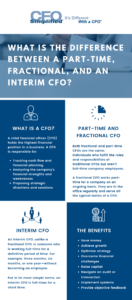
An interim CFO hourly rates in Massachusetts CFO usually fits a defined gap, such as a leadership transition, a loan process with a deadline, or a sale that needs organized financial preparation. A fractional CFO fits a company that needs regular senior finance attention without a full-time executive on the payroll. A permanent CFO fits a business whose finance needs are continuous, complex, and steady enough to justify a full-time role. None of these is better in general. Each one matches a different kind of work.
Whichever route you choose, Boston give the model one named owner who understands every assumption in it. A model that only one outside person can explain becomes a risk the day that person moves on. Ask the person building the model to walk you through the logic, line by line, and to show you where the main judgment calls sit. If you cannot follow the explanation, the model is not ready to take to a lender.
Check how the arrangement handles the handover. Ask for a written list of files, formulas, and assumptions at the end of the work, and ask whether your own team can update the model without help. A good structure leaves you able to run the next review on your own, even if the outside support is no longer there. If the work only lives in one person’s spreadsheet, the handover is the weakest link in the plan.
Consider how the work fits your calendar. A capital decision with a loan deadline needs focused time over a few weeks, while a quarterly forecast needs a steady rhythm for the rest of the year. Match the support to the shape of the work, not to a general wish for more financial expertise. Paying for the wrong pattern of help can cost you time and attention even when the expertise itself is excellent.
Give the lender a model they can follow and check
A lender does not need your model to look impressive. It needs to be clear enough to trust. Start with a short summary that states the purchase, the loan amount, the term, the expected incremental cash flows, and the main risks. Then attach the detail behind it. Someone reading the summary should understand the request in a few minutes, and the rest of the file should answer the questions that follow.
Show the assumptions in one place, with the source for each. Vendor quotes, past production records, and signed customer orders carry far more weight than a hopeful estimate. Mark which numbers are estimates and explain what would change them. A lender who sees that you know where the uncertainty sits is more likely to trust the parts you are confident about, because the model is honest about its limits.
Include the sensitivity results, not only the base case. Lenders often ask what happens if sales slow down, and a model that already shows the downside answers that question before it is asked. It also shows the owner has thought about the risk rather than hoping it stays away. A package that presents only the best case invites doubt, while one that shows the bad case calmly tends to build confidence.
Connect the forecast to actual history. If your current books are clean, a monthly cash flow statement for the last year makes the projections easier to believe, because the reader can see how the business has really behaved. If the books are behind or inconsistent, fix that first. A lender who reads unreliable statements will discount the whole package, however careful the new model looks on its own.
Prepare for questions about reporting after the purchase. Expect to explain how and when you will report results, and how you will track each covenant. A simple monthly package with cash position, sales, and covenant status is often enough to build confidence, and it keeps the relationship calm. A loan that comes with a clear reporting rhythm is far less likely to become a surprise in a difficult quarter.
Use one test before signing: can the project carry its own loan?
Before you sign, step back and ask one question. Setting aside Venture Growth Partners Support For acquisition Planning you have not yet earned, can the new asset’s cash cover the loan payments, the added running costs, and a reasonable cushion for a slow period? If the answer is yes in the downside case, you have a real basis for the decision. If the answer is yes only in the plan case, you are betting on a forecast that has not been tested.
Make the test concrete. Take the downside scenario, subtract the added running costs from the incremental cash flow, and compare what remains with the annual loan payments. If the remainder falls short, the business has to find that cash somewhere else. Decide now whether it can, and for how long, instead of working it out in the middle of a slow quarter when the options are fewer and the pressure is higher.
Hold the decision to the criterion, even when the asset looks attractive. A strong machine can still be the wrong purchase at the wrong time, and a modest one can be worth buying if the loan is structured well and the cash cover is comfortable. The loan and the asset should answer the same question together, and if they answer it differently, the loan should be the one that changes first.
If the test fails, the choices are not only yes or no. You might reduce the loan amount, lengthen the timeline, phase the purchase in stages, consider leasing, or wait until a customer commitment makes the volume more certain. Each option changes the cash picture, so run every version through the same test before you commit. The point is to compare real alternatives on equal terms, not to find the one that feels most comfortable.
Finally, write the result down with its date, its assumptions, and the person who owns the decision. A short record protects you when the first quarter looks different from the plan, and it gives the next review a place to start. Whether you keep the model in-house, hand it to an outside finance leader, or rebuild it later, the written decision keeps the reasoning intact after the loan papers are signed.